Europe is witnessing a summer of record-breaking heat, but the temperature itself is only one part of a much larger climate story.
Across Western Europe, extreme heat has coincided with worsening drought, declining river levels and devastating wildfires. At the same time, global sea-surface temperatures have reached another record.
For Bangladesh, thousands of kilometres away, the developments offer a warning of what a warming world could mean for a country already highly exposed to climate risks.
According to the European Union’s Copernicus Climate Change Service (C3S), Western Europe recorded an average temperature of 21.62°C across June and July, or 2.79°C above the normal average. The figure surpassed all previous records, including the previous record set in 2022.
Heat feeds drought
The prolonged heat has significantly reduced soil moisture across Western Europe, with conditions reportedly worse than during the severe drought of 2022.
As temperatures rise and soils dry, evaporation declines. This weakens the land’s natural ability to cool itself, allowing temperatures to rise further and intensifying drought.
The relationship matters for Bangladesh, particularly in its drought-prone northwestern districts. Higher temperatures can increase evaporation and crop water requirements, putting additional pressure on irrigation and groundwater.
Md Abul Basar, an anthropologist, governance expert and Team Leader at Swisscontact Bangladesh, said climate risks could no longer be viewed solely as environmental problems.
“Climate change is no longer only an environmental issue; it is directly linked to people’s livelihoods, water, food and social security. Local people’s experience and participation must therefore be placed at the centre of climate adaptation planning,” he said.
Roufa Khatun, Assistant Director of the Centre for Climate and Environmental Research (C3ER), said Bangladesh should view Europe’s experience as an early warning of interconnected climate risks. “Heat, drought and water stress can reinforce one another, making adaptation and early preparedness increasingly important for Bangladesh,” she said.
Falling rivers, wider risks
Europe’s drought is also affecting major rivers, including the Seine, Rhine and Danube.
Lower river flows can disrupt irrigation, inland navigation, industrial activity and power generation. In some areas, water shortages have created challenges for power plants that depend on rivers for cooling.
Bangladesh faces a different but equally important river-related vulnerability. Agriculture, fisheries, inland transport and rural livelihoods depend heavily on its rivers.
Wildfires expose another risk
The combination of heat and drought has fuelled major wildfires across Europe.
A wildfire in France’s Gironde region reportedly burned around 42,000 hectares, forcing more than 220,000 people to evacuate. In Spain’s Ávila province, approximately 44,000 hectares of forest were reportedly destroyed.
Bangladesh does not normally experience wildfires on this scale. But increasing heat and seasonal dryness underline the need for stronger fire preparedness in forests and vulnerable rural areas.
The ocean is warming too
The warning is not confined to land. According to Copernicus data, the average global sea-surface temperature outside the polar regions reached 20.96°C in July, exceeding the previous record of 20.89°C set in 2023.
For Bangladesh, ocean warming deserves particular attention because of its dependence on the Bay of Bengal.
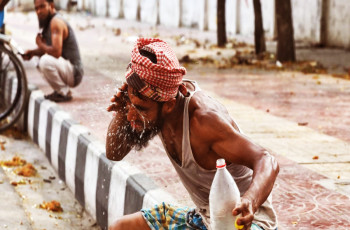
Heat is becoming a public-health issue
Bangladesh is particularly vulnerable to extreme heat because high temperatures are often accompanied by high humidity.
Md Shamsuddoha, Chief Executive of the Center for Participatory Research and Development (CPRD), said Bangladesh must broaden its approach to climate adaptation.
“Climate adaptation in Bangladesh cannot remain limited to floods and cyclones. Heatwaves, drought, water shortages and urban climate risks must receive equal attention. Strengthening early warning systems and local adaptation capacity is now essential,” he said.
Bangladesh needs a compound-risk strategy
Europe’s experience demonstrates why Bangladesh cannot treat climate risks as isolated events.
Heatwaves, droughts, floods, water shortages, salinity and sea-level rise can interact and amplify their impacts.
Bangladesh needs a stronger national Heat Action Plan, climate-resilient agriculture, efficient irrigation, improved river monitoring and better dry-season water management.
Cities also need more trees, open spaces, water bodies and heat-resilient infrastructure. In coastal areas, adaptation should combine freshwater security, resilient agriculture, fisheries protection and ecosystem restoration.
SM/CitizenTimes