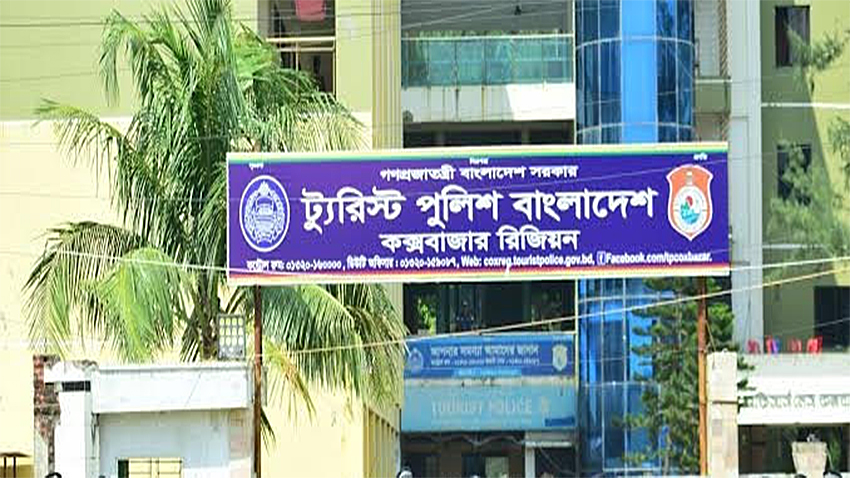
Cox's Bazar sea beach is one of the country's most important tourist destinations. Every day, alongside domestic and foreign tourists, numerous small-scale traders work here to earn a living.
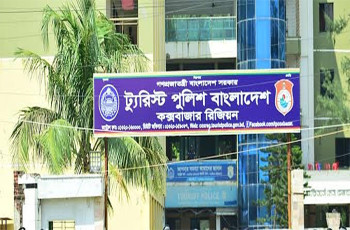
As the relevant authority, the Tourist Police bear the crucial responsibility of ensuring tourist safety, preventing harassment, and maintaining order on the beach. Amidst this, allegations have surfaced against the Tourist Police for collecting money from hawkers under the guise of providing security or giving advance notice of enforcement drives.
Many people have taken up hawking at Cox's Bazar beach to make a living. Some sell *gula* (a local snack), others sell betel leaf (*paan*), and some offer various products to tourists. They support their families with the meager income earned at the end of the day. However, even in this pursuit of a livelihood, there are allegations of having to pay money to the Tourist Police.
Several hawkers operating at the beach's Sugandha Point claim that money is collected from them multiple times a day to allow them to continue their business. They allege that these funds are collected for the Tourist Police; in exchange, they are promised security and advance information regarding raids by the tourism magistrate. These details came to light during an on-the-spot visit to Sugandha Point on Friday afternoon, where hawkers shared their experiences. Tourist Police authorities have denied the allegations of such extortion and warned of legal action against those involved.
A hawker was selling *gula* while standing at Sugandha Point. While speaking with him—during which he was eating fruit—an individual arrived, collected money, and left. When asked what the money was for, the hawker explained that he had come to the beach out of necessity; having lost everything else, he, along with his parents, supports the family by selling *gula*.
However, he alleged that he is required to make payments three times a day to continue his business. According to him, a payment of 30 Taka is required each time during the afternoon, evening, and night—totaling 90 Taka per day. He explains that for a hawker operating with limited capital, this regular payment imposes an additional financial burden, yet there is no option to avoid it.
The hawker alleges that failing to pay leads to difficulties in running the business, or even results in being barred from trading altogether. He states that this money is paid for the Tourist Police. While speaking with the hawker, a *paan* (betel leaf) vendor arrived, collected the money, and left. When asked about the matter, the hawker reiterated that the payment was for the Tourist Police, claiming that the *paan* vendor collects the funds from hawkers on the beach. An attempt was later made to follow and speak with that individual. When asked to identify himself, he gave his name as Sultan. He hails from the Haldia Palong area of Ukhiya Upazila in Cox's Bazar. He claimed to have been involved in the *paan* trade at Cox's Bazar beach for nearly nine years, while also collecting money from hawkers.
When asked the reason for the collection, Sultan explained that the funds cover "tea and refreshment" expenses for relevant personnel—specifically to ensure the hawkers' security and to provide advance notice regarding raids by the tourism magistrate. He claimed that since these officials support the traders, he collects the money and delivers it to the respective office. He further mentioned that he receives a share for his collection work. However, when asked who pays him that share or how much he receives, he said, "There are more tourists on Fridays and Saturdays, so I collect more money from the hawkers and get a portion of it myself." Sultan claimed that instead of handing the money to a specific individual, he delivers it directly to the Tourist Police office to avoid the matter becoming public knowledge through discussions on the beach.
**Fear of Speaking Out; Risk of Business Closure** Another trader on the beach, speaking on condition of anonymity, revealed that they have been forbidden from openly discussing the payments. They warned that if any trader speaks to journalists about this issue, they will no longer be allowed to conduct business. "We would be in dire straits then; they wouldn't let us run our businesses." According to him, it is already difficult to support a family on the income generated from small-scale businesses at the beach.
Having to make regular payments further cuts into their profits. Moreover, there is a fear that their businesses could be shut down if the issue of these payments were to be exposed. When asked about the allegations regarding the collection of money from hawkers, Bikash Chandra Chowdhury, the Administrative Officer of the Tourist Police (Cox's Bazar Region), denied the claims. He stated that action would be taken against anyone identified as being involved in such incidents.
He subsequently disconnected the call, citing a busy schedule. Meanwhile, Sharif, the in-charge of the Tourist Police help desk at Laboni Point, stated that they were unaware of the matter. He added that they had no knowledge regarding such money collection practices.
An attempt was made to obtain a statement from Uttam Prasad Pathak, the Superintendent of Police for the Tourist Police (Chattogram Region), but he indicated that he would speak about the matter later.
SM/CitizenTimes