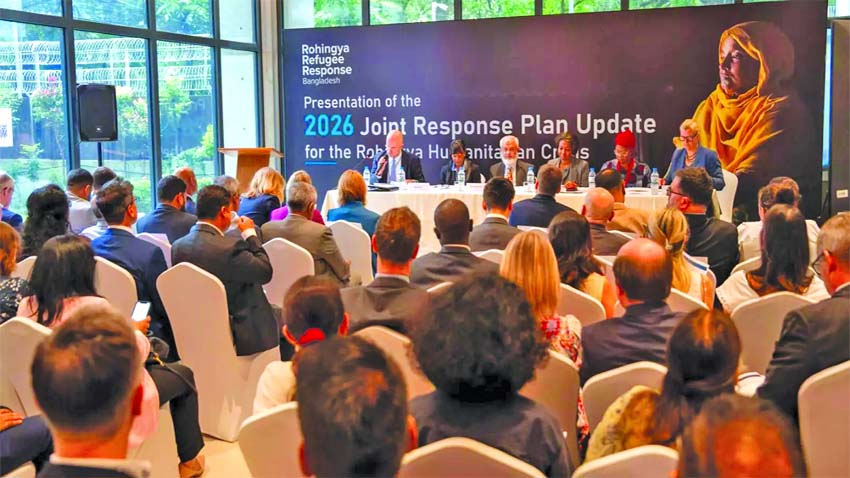
The United Nations and its partners, in close coordination with the government of Bangladesh, on Wednesday called for renewed international support, appealing for USD 710.5 million to meet the most critical needs of Rohingyas in the Cox’s Bazar camps and on Bhasan Char, as well as local host communities.
The call came amid growing global instability and rising humanitarian pressures, which have forced difficult prioritization and threatened essential services for vulnerable populations.
The 2026 JRP update was presented at the UN House in Dhaka by Kelly T. Clements of UNHCR, Rania Dagash-Kamara of WFP, Nyaradzayi Gumbonzvanda of UN Women, M. Forhadul Islam, acting Foreign Secretary of Bangladesh and Secretary for Intergovernmental Organizations at the Ministry of Foreign Affairs; and Carol Flore-Smereczniak and United Nations Resident Coordinator.
The appeal is supported by 98 humanitarian partners, including 52 Bangladeshi organisations.
The humanitarian community reiterated that the most desirable and durable solution to the Rohingya crisis is the voluntary, safe, dignified, and sustainable return of refugees to Myanmar.
Until conditions in Myanmar are conducive, continued international solidarity and support remain essential, not only as a humanitarian imperative, but also to uphold human rights, preserve regional stability, and ensure that refugees and their host communities are not abandoned, according to the UN Refugee Agency.
Sustained international assistance remains crucial to bolstering Bangladesh’s response as it continues to generously host refugees until a durable solution is achieved, said UNHCR.
Nearly a decade after fleeing targeted violence and persecution in Myanmar, some 1.2 million Rohingya refugees now reside in Bangladesh. Needs continue to rise as conflict in Myanmar forces more people to flee.
Since early 2024, some 150,000 Rohingya have newly arrived, straining limited humanitarian resources and intensifying pressure on overcrowded camps.
Officials told UNB that Bangladesh is now hosting over 1.3 million Rohingyas in Cox’s Bazar and Bhasan Char.
The scaled-down, hyper-prioritised 2026 update of the Joint Response Plan (JRP) for the Rohingya humanitarian crisis will reach up to 1.56 million people, including refugees and Bangladeshi host communities.
The USD 710.5 million appeal, 26% lower than in 2025, covers only the minimum required to sustain lifesaving assistance. It includes USD 247.3 million for food, USD 128 million for shelter, USD 61.2 million for water, sanitation and hygiene, USD 52.7 million for education, USD 49.9 million for health, and USD 35.1 million for livelihoods and skills development.
It also includes USD 36.2 million, across all sectors, in support for host communities affected by the crisis.
From 2017 to the end of 2025, the international community has contributed nearly USD 5.42 billion in humanitarian funding to the Rohingya response, with the United States remaining the largest donor, allowing Bangladesh to sustain lifesaving assistance and making possible major progress in refugee education, health and protection. Risk of Losing Precious Gains
However, the UN agency said, significant humanitarian needs persist and, without continued international solidarity, Rohingya families risk losing precious gains.
Deputy High Commissioner of UNHCR, the UN Refugee Agency, Kelly T. Clements said they must continue to provide safety, care, and dignity where the Rohingyas are until they can return home in safety and can rebuild their communities in Myanmar.
“As resources become more limited, it is more important than ever to help refugees build skills and resilience, so they can gain independence, hold on to hope, and rebuild their lives,” she said in Dhaka on Wednesday.
Kelly said the humanitarian community is working hard to deliver this support as efficiently as possible as they continue to see resources decline. “But the needs remain enormous, and efficiencies alone cannot offset the very real impacts of funding cuts on the Rohingya people and the impact on their host communities. Helping the refugee community become more self-reliant remains a crucial goal,” she said.Assistant Executive Director for Partnerships and Innovation at the UN World Food Programme Rania Dagash-Kamara said Bangladesh has shown extraordinary generosity in hosting this highly vulnerable population, and they are deeply grateful to their donors who have continued to stay the course.
S.M./CitizenTimes